
 Watch on YouTube
Premieres 26 October 2026 at 6pm UK time
The Old Fox's Library · Episode 6
What did you win at the first Olympics?
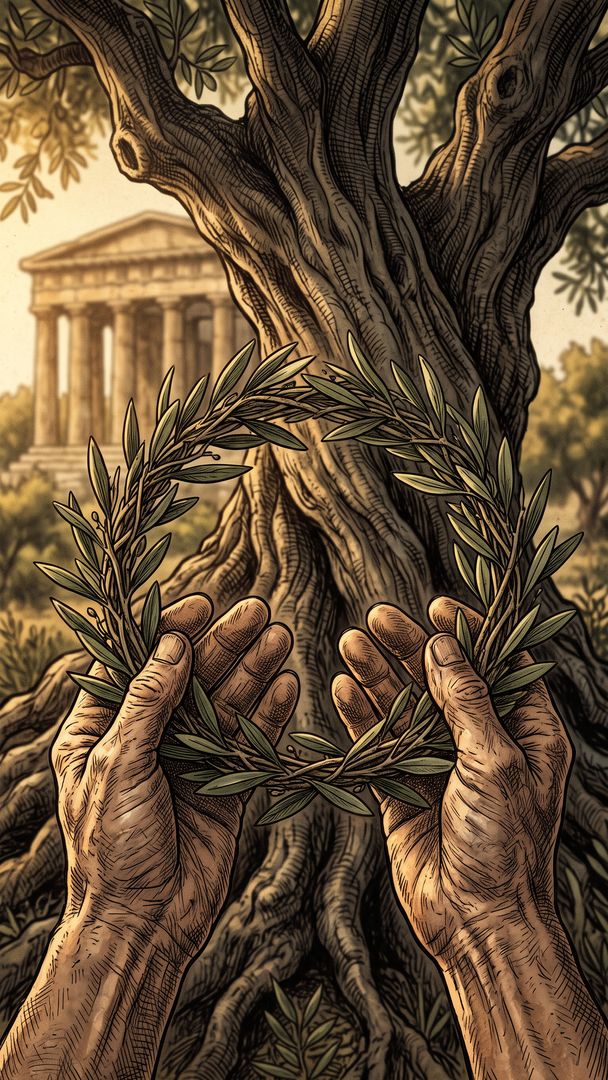
No medal. Just a wreath of wild olive.
The ancient Games at Olympia: a single sprint that tradition says a cook won, naked athletes, the sacred truce, the Heraia races for girls, and a Spartan princess who won without holding the reins.
Watch on YouTube Follow on TikTok
Share this story
What the fox said
Pull up a chair. Tonight's page: the first Olympic Games.
Olympia, in southern Greece: a holy place of Zeus, where the Games were held every 4 years.
Tradition says it began in 776 BC, with a single sprint. A cook won.
Later came longer races, wrestling, boxing, the pentathlon, chariots, and the pankration: a fight with almost no rules.
Athletes competed naked. The prize? No medal. Just a wreath of wild olive, cut from a sacred tree.
Heralds announced a sacred truce, so visitors could travel to Olympia safely.
Married women were barred from watching. One ancient writer says rule-breakers faced being thrown off a mountain.
Unmarried girls, he adds, could watch, and they had their own races: the Heraia, for the goddess Hera.
One woman even beat the men. Kyniska, a Spartan princess, won the chariot race in 396 BC.
The crown went to the horses' owner, not the driver. She won without ever holding the reins.
The ancient Games ran for over 1,000 years, usually said to end around AD 393.
In 1896, Athens brought them back, and a Greek, Spyridon Louis, won the marathon to a roaring home crowd.
Close the book. Keep your nose to the wind.
Sources
- The ancient Games were held every four years at Olympia, a sanctuary of Zeus in the western Peloponnese, with a sacred truce so athletes and visitors could travel safely (Encyclopaedia Britannica; Olympics.com; Perseus, Tufts University, 'The Olympic truce').
- Tradition dates the first Games to 776 BC, though the exact start is unknown; the first event was a single sprint, the stadion, of about 192 metres (Olympics.com; Encyclopaedia Britannica, 'Stade').
- Tradition says the first recorded winner was a cook, Koroibos of Elis (Encyclopaedia Britannica, 'Coroebus of Elis').
- Athletes competed naked, and the prize at Olympia was a wreath of wild olive, not a medal (Perseus, Tufts University; Metropolitan Museum of Art; Olympics.com).
- The ancient writer Pausanias records a law that married women caught watching the men's Games be thrown from Mount Typaeum, and adds that unmarried girls were allowed to watch; girls also raced at their own festival for Hera, the Heraia (Pausanias, via Fordham Ancient History Sourcebook; Archaeology magazine; History.com).
- Kyniska, a Spartan princess, won the four-horse chariot race in 396 BC; the victory went to the owner of the horses, not the driver (The Conversation; CAMWS; Pausanias).
- The ancient Games are usually said to have ended around AD 393, more than 1,000 years after they began, though the date is debated; the first modern Games were held in Athens in April 1896, where Spyridon Louis of Greece won the marathon (Encyclopaedia Britannica; Perseus, Tufts University; Olympics.com).
Spotted a mistake? Tell us in the YouTube comments and we'll correct it.